
Most companies only discover the gaps in their time tracking when someone asks for the records – for example, the occupational safety authority or customs, wanting to see the last few months of working-time records. At that point, even the best work doesn’t help if the records aren’t there.
In short: Up to €30,000 per violation under the Working Hours Act, up to €500,000 under the Minimum Wage Act. In practice: €400 per break not granted, €1,600 per employee without correct records. Because each violation counts separately, it quickly reaches five figures.
Who actually inspects?
State occupational safety authority → in Baden-Württemberg, the Gewerbeaufsicht. Checks the Working Hours Act: maximum hours, breaks, rest periods, records. Applies to every company.
Customs (Financial Control of Undeclared Work) → checks the minimum wage. Mainly relevant for mini-jobbers and sectors like construction, hospitality or logistics.
Inspections are becoming more frequent: since 2026, the Occupational Safety Act requires every federal state to inspect at least 5% of businesses each year (§ 21 (1a) ArbSchG). These inspections cover occupational safety as a whole, not just working time. The most common trigger for a targeted working-time inspection is still a complaint – often from someone who has just left the company.
What individual violations cost
The law sets the upper limits: €30,000 for most violations of the Working Hours Act (§ 22 ArbZG), €5,000 for a missing notice. What is actually imposed is set by the states’ fine catalogues, most of which follow the LASI model catalogue:
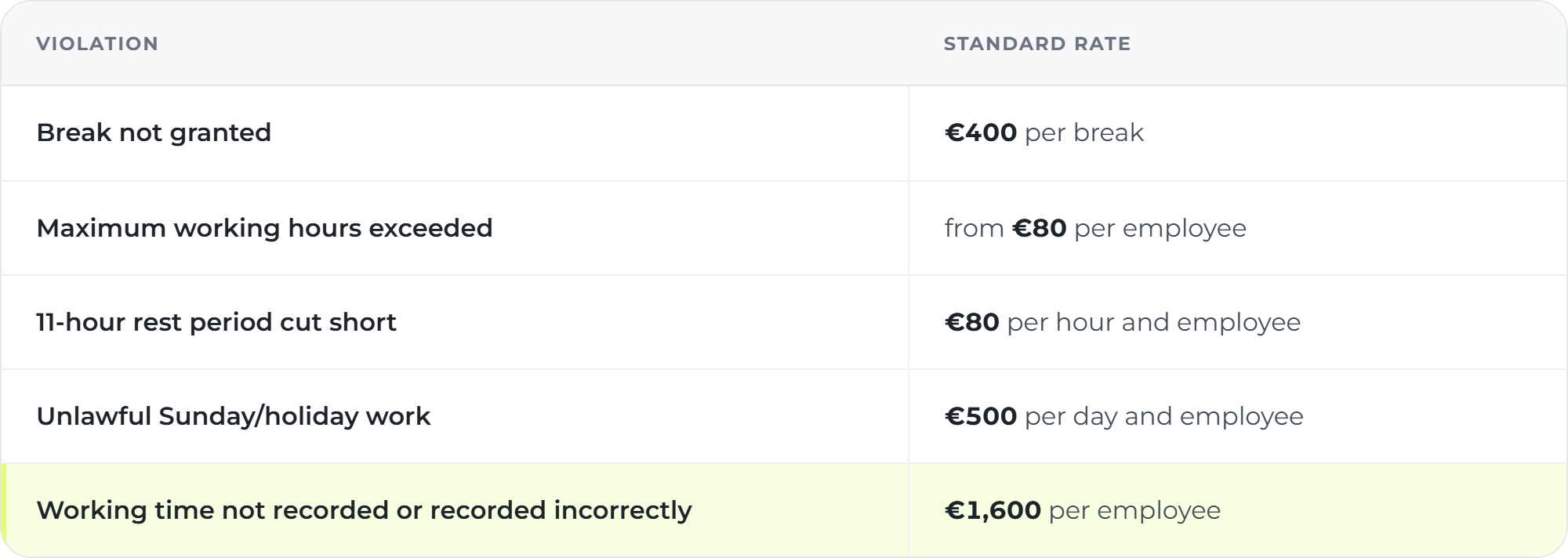
An example: An IT services company with 30 employees collects hours in Excel – one number per day, no start, end or breaks. After a complaint, the authority finds: 12 people with overtime not recorded (€19,200), 4 people with no break on 6 days each (€9,600), plus minor rest-period violations. Total: just over €30,000 – even though no single violation reaches the statutory maximum.
When it becomes criminal
Under § 23 ArbZG, an administrative offence becomes a criminal one if violations of working hours, breaks or rest periods endanger an employee’s health or are persistently repeated. That means up to one year in prison or a fine. Missing records alone aren’t a criminal offence – but they’re exactly why such violations go unnoticed until it’s too late.
Liability doesn’t just sit with “the company” – managing directors can be held personally liable. And some consequences aren’t in the fine notice: fines over €200 are entered in the central trade register, and a minimum wage fine of €2,500 or more can exclude a company from public contracts.
What’s changing
Since the Federal Labour Court’s 2022 decision, employers must record all working time. There’s currently no direct fine for this – only once the authority orders a system to be introduced. That’s set to change: in June 2026, a new draft bill from the Federal Ministry of Labour (in German) became public. It replaces the 2023 draft, which was never adopted by the cabinet. It provides for mandatory electronic recording, with transition periods depending on company size; businesses with up to ten employees may continue recording on paper. As of October 2026, the ministries are still coordinating – nothing has been passed yet.
Documents to have ready
Time records for all employees covering the last two years
Posted copy of the Working Hours Act and applicable collective or works agreements
Duty rosters and shift plans
Employment contracts, payslips and proof of payment (especially for customs)
For mini-jobbers and sectors under § 2a SchwarzArbG: start, end and duration of working time, recorded within seven days
How Fritto helps
Fine risks rarely arise because someone deliberately cuts corners – but because records are scattered, incomplete or impossible to reconstruct afterwards.
Traceable: every time entry shows who created and changed it, and when – the audit trail Excel can’t provide.
Ready fast: a report for any period and all employees is a few clicks away.
Approval built in: red flags like ten hours without a break surface internally, not during an inspection.
Safely stored: data sits on servers in Germany – still there two years later.
Conclusion
€400 here, €1,600 there – it gets expensive because every break, every day and every person counts separately. The fix isn’t a major project: time tracking the team uses without effort, ready at the push of a button when an inspector asks.